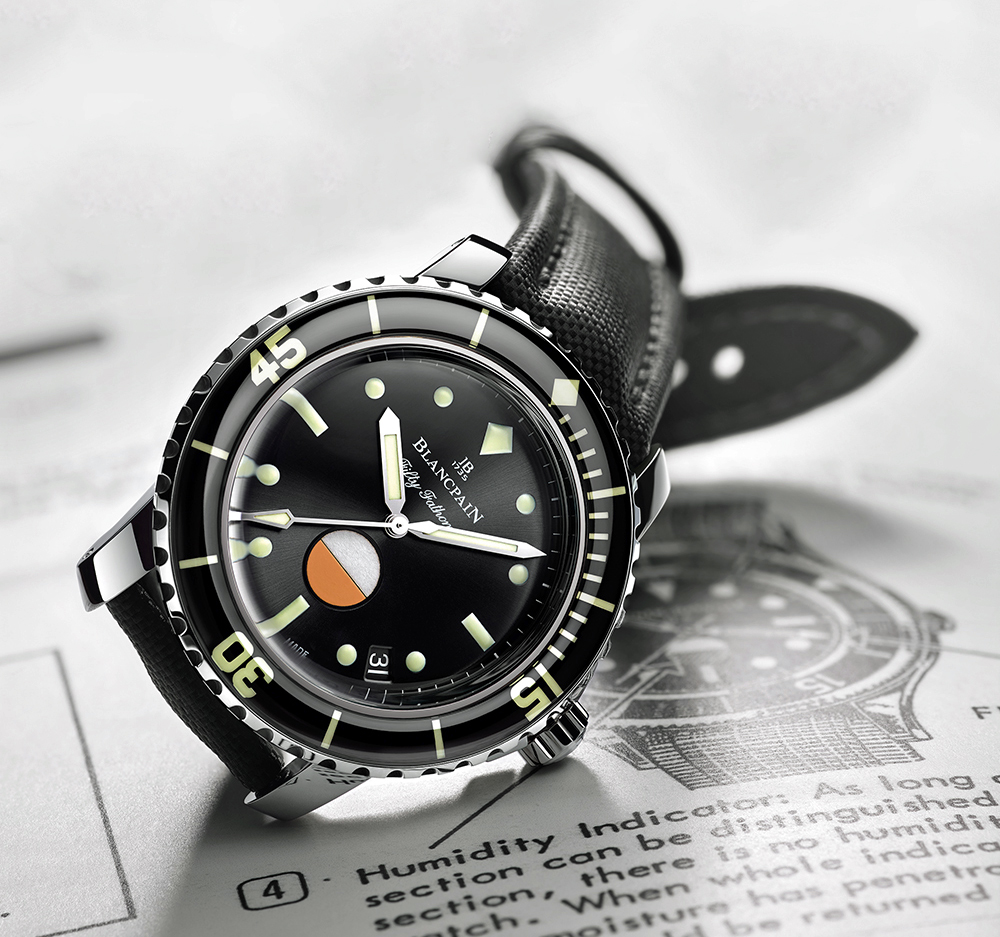
Most dive watches will never go deeper than a hotel pool. That is not a flaw; it is their genius. Built for the extreme, they are wonderfully reliable for the ordinary: a rotating bezel to time a parking meter, a dial you can read in a dim restaurant, water resistance that shrugs off a downpour.
1953, the year it all began
Fifty Fathoms
It started with a military order. The French navy's combat swimmers needed a watch that could follow them underwater, and Blancpain delivered the Fifty Fathoms in 1953, named after an old British measure of about 91 metres. The same year Rolex developed the Submariner, which reached the market in 1954. Together they set the codes of an entire genre.
A dive watch is the elegance of a tool you never use.
The international ISO 6425 standard defining a diver's watch only arrived in 1982, revised in 1984 and 1996. Meanwhile the technology moved on: Blancpain's power reserve went from 38 hours in 1953 to 120 hours today.
To wear one in town, mind the size: around 38 to 41 mm slips under a shirt cuff and suits most wrists. On steel it is sporty; on leather or canvas it becomes surprisingly dressy. You buy it for the sea. You keep it for everything else.